Average Reviews:

(More customer reviews)My original in-depth A550 review was done long before the A580/A560 and A55/A35 came out. They are game changers. This is still an A550 review, but it won't mean much unless I provide some context relative to the new designs. I'm going to summarize the key differences first so maybe you can avoid the long, in-depth discussion of features that follows. If you decide to skip over most of the info, you might just glance at the last two or three paragraphs before moving on.
The A580 and A560 are in essentially the same shell as the A550 and A500. They build on the technology of those designs. The biggest difference is the addition of HD movie shooting. The still-camera differences include marginally increased resolution (A500 = 12.3 megapixels, A550 = 14.2, A560 = 14.2, and A580 = 16.2). This is no big deal except for bragging rights. Be aware that Sony makes its own sensors and makes sensors for some of its competitors. Given Sony's obvious corporate priority on DSLR market share, we have to believe that they won't sell their very best to competitors.
The A580/A560 includes some new features relative to the A550/A500: mirror lock-up on self-timer, which may make a difference for ultimate sharpness on non-hand-held shots; depth-of-field preview, so you can see how much of a scene is in focus before you shoot; a new "hand-held twilight mode," which will significantly reduce low-light noise, may reduce blur and camera shake effects, but may only make sense for near-motionless scenes; and 3D panorama, which will allow you to sweep across a scene and "paint" a wide, panoramic frame.
There are other upgrades, which Sony claims will enhance features that already exist. These include better/faster autofocus, and a very significant improvement to the HDR mode. The autofocus speed on the A500/A550 does not, for me, need improvement so I don't know how to evaluate that upgrade. The in-camera HDR is a trick of reducing loss of detail in shadows while simultaneously reducing white-out of ultra-bright parts of the picture. It only works on static scenes, but it already works well on the A500/A550 (it's one of my favorite Sony exclusives). The use of three frames will double its potential dynamic range advantage as well as make it more practical. I have a more in-depth discussion of the feature later.
If you will make good use of the movie feature, the choice between the one-year-old technology and the new technology is a no-brainer: buy the new. For still-pictures alone, the new technology is easily worth an extra $150 to me personally. An extra $250, however, is a resounding MAYBE for me just based on still-camera differences. I say that, because I've done a wide range of work with the A550, and I absolutely love the camera just like it is. Sometimes better is the enemy of good-enough. I also have an A850, so I can make direct comparisons to it. At the time of this review, the A580s are hard to find, and where they are available, they come only with the kit lens, and vendors are asking over $800. The A560s, a very attractive compromise, aren't even on the market yet.
So what about the A35 and A55? They are not true DSLRs, because they don't "reflex" the mirror. The mirror is partially reflecting, or "translucent," with 30 percent of the light going up to an electronic viewfinder's (EVF's) sensor while 70 percent goes through to the main sensor. The mirror is stationary: it doesn't flip up for picture taking like an SLR. This eliminates mirror slap noise and vibration altogether, but there is no true optical finder, and the main sensor loses light input. They do, however, do an excellent job of shooting movies with autofocus; they are smaller and lighter; and they are quieter than DSLRs. I've tried an A35: the EVF is excellent and can display more info than you can get in an optical finder's window. The loss of light to the sensor equates to loss of 0.514 stop; one third of the effective area of the lens' front optic is lost to the sensor; or, stated one more way, it is equivalent to increasing your lens f-number by 20 percent. (Please, before you disagree, look up the formulas: there are logarithms to base 2 involved.) There is no general loss of contrast, but one reviewer reported measuring image ghosting in the A55. The ghosting will show up as a very thin bright line on the dark side of a bright-dark interface in a picture. The ghosting was down 200x in intensity from the main image (meaning Sony has done a good job of coating the mirror glass.) Message: it is unlikely to matter. Beyond this point, discussions of differences between the A550 and the newer models will be mostly confined to the A550/A500 versus the A580/A560.
In the first version of this review, I wrote that the A550 was ahead of every other camera on the planet (except the A500) in three areas that are critical to non-professionals:
1. low light performance - it is excellent out to ISO 6400 (Pros care about this too.) The A550 is better in this regard than the A900. The A560/A580 "hand-held twilight" feature will further improve noise reduction in dark areas of your pictures of near-static subjects with no loss of picture detail.
2. fast-focusing live view with tilt screen, which is slightly better than two other Sony offerings (350 and 300) and beats all other brands like a drum. Sony has enhanced the fast focusing in the A560/A580, but it's impossible to know how much the enhancements matter in real-world use without testing.
3. high dynamic range (HDR) feature, which, for stationary subjects, will bring images out of the shadows with full detail, like you won't believe. The longer exposure of dark areas will reduce grain. Going to three frames definitely makes this even better in the A560/A580 as I'll explain later.
The following are negatives on the A550 that I pointed out in my original version of my review. I'm now adding comments about the A560/A580's impact on these issues:
1. no mirror lock-up on the A550, not even with the self-timer. Locking up the mirror eliminates any blur-inducing vibration associated with "mirror slap" when pictures are taken. You don't use mirror lockup in hand-held shooting, because it blinds both the viewfinder and live view. The A560/A580 has preliminary lockup on self-timer shots, which, for me, all but eliminates this shortcoming. The A55/A35 eliminates this problem altogether.
2. no program shift, although there is a very useful manual-mode shift, which is often overlooked altogether by professional reviewers. The new designs did not remedy this shortcoming.
3. no depth-of-field preview. The A560/A580 does have depth-of-field preview.
So of my three original superlatives, two out of three have definitely been enhanced with the A560/A580, and the third has as well, at least at the specification level. The new models have also eliminated two out of three of my originally identified shortfalls in the A550. The only outlier is the lack of program shift.
Lately, I've noticed some bloggers bashing the A550 for not having an ISO 100 setting. The A580/A560 has it. We photographers are conditioned to believe that ISO 100 is what you use (when conditions allow) to get the very lowest-noise shots. When we see the A550 not having an ISO 100 setting, we jump to the conclusion that it is not a serious pro-sumer camera. We are wrong when we do that. The ISO of the A550's native sensor is 200, and there would be no benefit in grain or noise reduction by going to 100. What is the A580's native ISO? I don't know, but the A580/A560 manual, which I downloaded, leads me to believe the native ISO is 100. I do know that the professional-grade A900 has an ISO 100 setting, but that sensor is native-200, which means that going to ISO 100 amounts to "throwing photons on the floor." It's equivalent to using a (very high quality) 50 percent neutral density filter. Come on, bloggers, how many of you have really ever used a neutral density filter? In the A550, Sony refused to design its settings around photographers' incorrect pre-conceptions about optimum sensor performance. (There must come a point when more light is no longer better, and nothing in physics says that the point must be ISO 100. It could be 200, 100, 50, 25 or whatever. After all, with all the new anti-shake technology you could often shoot at ISO 25.) Did Sony give in to users' pre-conceptions in the A580? We'll find out later when we learn more about the senor. In the words of Forest Gump, "That's all I have to say about that."
The rest of this review will explain the six features identified above and their associated benefits and liabilities, point out some other key discriminators, provide recommendations for sources of additional information, and offer suggestions for accessory purchases. I'll note one other important item that the professional reviewers, to a man, got wrong about the A550. Finally, and you may want to skip ahead to this, I'll cover the differences between the A550 and the A500, from one real-world user's perspective.
There are three kinds of potential buyers for this camera: those who already own a Sony or a Minolta autofocus SLR (digital or film), those who own another brand of autofocus SLR, and those who would be newcomers to autofocus SLRs but typically already have compact digital cameras. Most of the first group is pretty much already in Sony's pocket, because they have sunk cost in lenses and accessories that they can use on the A550/A500 or a newer model. The second group will be a very hard sell because they're fully vested in another brand. The third group is wide open, and the obvious opportunity for Sony's DSLR brand...Read more›
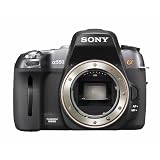
Click Here to see more reviews about: Sony Alpha DSLR-A550 14.2MP Digital SLR Camera (Body Only)
For a higher level of performance, step up to the Sony a550 DSLR camera. Enjoy the freedom of Quick Auto Focus and Manual Focus Check Live View on the tiltable 3.0LCD. Experience the responsiveness of up to 7fps Speed Priority mode. Relish the clarity of 14.2MP and up to ISO 12800 sensitivity. Capture the full range of light and shadow with Auto HDR.
 Get 12% OFF
Click here for more information about Sony Alpha DSLR-A550 14.2MP Digital SLR Camera (Body Only)

0 comments:
Post a Comment