Average Reviews:

(More customer reviews)
Canon has three digital cameras for $2,500+. The 1DS Mark II, the 1D Mark IIN and the relatively new 5D. I chose Canon over Nikon (which I've shot most of my photographic life) because of Canon's more impressive suite of lenses. Here's the decision process I went through. As with most products, it comes down to how you'll use it. All of them have tradeoffs.
1. Megapixels. More pixels - with a few caveats - translates into an image that can be enlarged (and cropped more tightly)with less deterioration. The 1DS is the market leader at 16.7MP, the 5D comes in at 12.7MP and the 1D at 8.2MP. If you're a commercial art or magazine photographer the 1DS probably makes sense. If you're a wedding photographer, the 5D is probably the sweet spot. In practice, however, the difference in pixels between these cameras will not make an appreciable difference for most people. At 8.2MP, you can make an 11x17 print at 200 pixels/inch without any enlargement beyond the camera's native resolution. Up to that size, you certainly won't see much difference in prints from the three cameras. That said, the higher megapixels of the other cameras gives you more extreme cropping lattitude.
2. Full frame. The 1DS and 5D are full frame - that means the sensor in the camera will capture the view of the scene that you're accustomed to seeing with your 35 mm film camera. The 1D and most digital cameras have what is called a field of view crop factor (FOVCF). For the 1D, it's 1.3X. What that means is that both the viewfinder and the image sensor don't capture everying the lens is "seeing" - it crops the view in a little tighter. The result: your lenses are effectively 1.3X longer. A 70 mm lens becomes a 91 mm lens and so on. Because the camera is effectively "cropping" the edges of the image that the lens produces, it also tends to eliminate the softness or vignetting that appears at the edges of some lenses. Whatever camera you use, what you see in the viewfinder is still what you get, and it doesn't affect the pixel resolution of the image. My 300 mm lens with a 1.4X extender and a 1.3X FOVCF is effectively a 546 mm lens - getting into birding territory. (If you're switching from film to digital, some of your lenses may may no longer fit your needs with the FOCVF. Your 35 mm lens is no longer really a wide angle at 45 mm.)
3. Durability. This was most important to me, though it may not be for someone who doesn't shoot in extreme conditions or expects to replace their camera in two years. Both the 1Ds and 1D sport complete metal bodies, sealed against the weather with a shutter that will last at least 200,000 cycles. The 5D - a very solid camera - is designed for 100,000, is not weather sealed and has more plastic components.
4. Weight/size. What a solid, metal body giveth in durability it taketh away in weight. For those who prefer a camera with heft, these have it. For many people, this is a big drawback. The 1DS and 1D are 43 oz., or almost three pounds for just the body, without the big battery. Add the battery and you're at 54 oz. The 5D is just 29 oz. and 31 oz. with battery. The 1DS and 1D, with built-in vertical grips, are also more than 2 inches taller. If you're looking for something less obtrusive and easier to carry around, the 5D is it.
5. Speed. There's a reason the 1D is the camera of choice for photojournalists, sports and many bird photographers. It shoots at a smooth 8.5 frames per second, compared to 4 fps for the 1DS and 3 fps for the 5D. For most day-to-day uses, 3 fps is more than adequate. From using both, I'd say the 1D autofocuses a bit faster, too. The 1D has 45 autofocus points, compared to nine for the 5D.
6. Price. Give or take a hundred here or there, the 1DS is about $7,200; the 1D about $3,900; and the 5D about $3,000. Price will determine whether you get the 1DS or not. If you can afford it, go for it. Otherwise, other features - or the possiblity of buying more lenses instead of more camera - will make your decision.
What did I decide? First, I looked at how I'd use the camera: photojournalism, travel and wildlife photography. The higher FPS was not as important to me as durability and autofocus speed, so either the 1D or 1DS would do. In the end, I decided I'd rather spend the money on lenses that would not be obsolete with the next new and improved camera. (I bought the 300 f/2.8 IS for close to the difference in price.)
So, I went with the 1D Mark IIN. If my camera was generating some good cash flow or my wife didn't need a new car, I'd probably have gone with the 1DS. I'm VERY happing with the decision and the camera.
For most people and most uses - general portrait, landscape and travel photography - the 5D is probably the way to go. (Or perhaps the next greatest camera that Canon will announce later this year.)
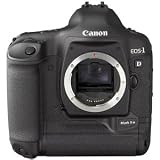
Click Here to see more reviews about: Canon EOS 1D Mark II N 8.2MP Digital SLR Camera (Body Only)
The EOS-1D Mark II N is an upgrade of the award-winning EOS-1D Mark II. Still featuring 8.2-megapixel performance at 8.5 frames per second, the upgraded camera has a higher performance buffer to deliver a 48 frame burst in JPEG and 22 frame burst in RAW. LCD monitor size increases from 2.0 inches to 2.5 inches, and dual CF and SD memory card slots provide for separate RAW and JPEG recording. Color Matrix and parameter settings are replaced with Canon's new Picture Style--6 pre-sets that simplify in-camera control over image optimization and processing.

Click here for more information about Canon EOS 1D Mark II N 8.2MP Digital SLR Camera (Body Only)

0 comments:
Post a Comment